Hard Set
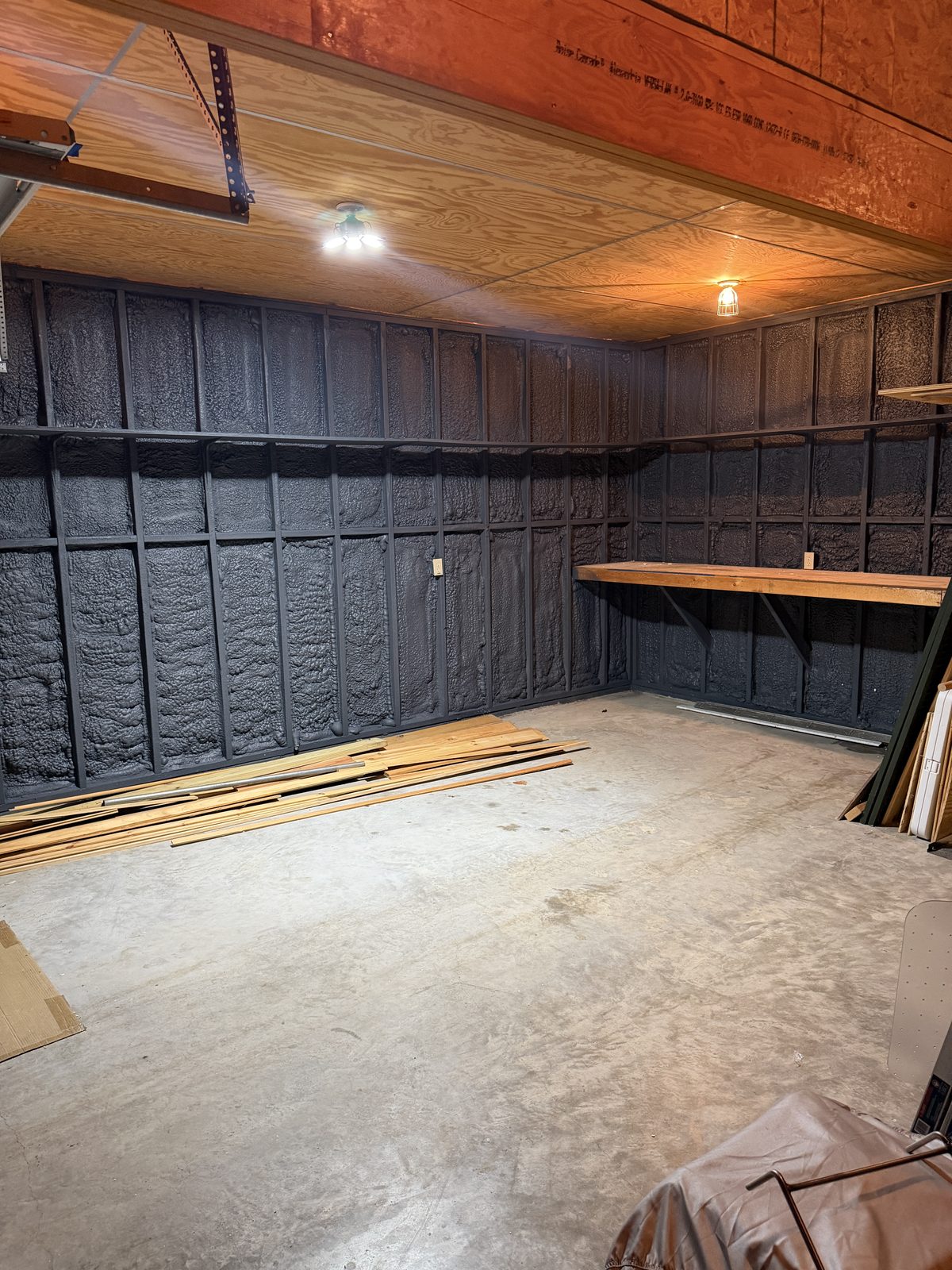
The foam on the walls is the color of a storm cloud – gray-charcoal, rough-textured where it cured against the studs. Run a finger across it and it doesn’t give. That’s the point.
Closed-cell spray polyurethane goes on as a liquid: two chemicals that hit the air together, expand fast, and lock hard in under a minute. At full cure it runs about two pounds per cubic foot. Not fluffy. Not spongy. Rigid, like something that grew into the cavity and filled every corner, every fastener hole, every gap the framing left behind.
The R-value is around six to six-and-a-half per inch – roughly double what open-cell foam or fiberglass batts give you at the same thickness. In a shop with shallow stud bays, that matters. You can’t keep adding inches to solve a problem you don’t have room for.
The R-value isn’t really why I chose it.
Closed-cell does something open-cell can’t: it stops moisture. At two inches it acts as a vapor retarder; it doesn’t absorb water; it seals the building tight in one pass. Air barrier and vapor barrier are the same layer. No seam between them, because there’s no seam.
Open-cell is the cheaper option. Softer. It absorbs sound better. And people describe it like those are virtues, which they sometimes are. The word they use is “breathes.” Open-cell breathes.
That’s a nice word for lets moisture through.
In a shop, moisture is the enemy. Tools rust. Wood moves. Temperature swings. A garage door opens in January and closes in July and the air inside does whatever the air outside was doing three days ago. I didn’t want that. I wanted the shop sealed against the weather, stable, dry – a box that holds its own climate instead of borrowing one.
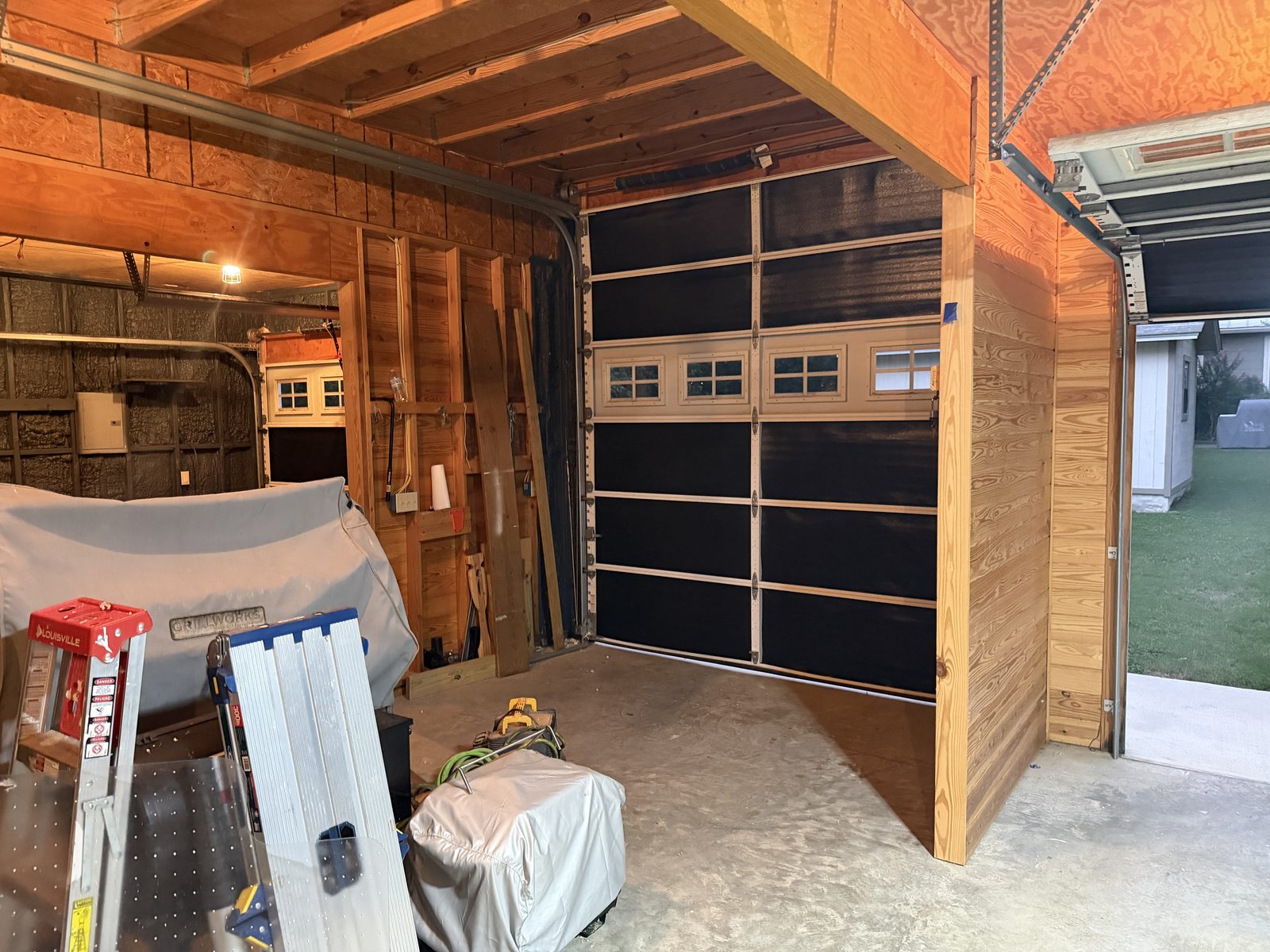
I’m putting climate control in here, and that only pays off in a tight envelope. Condition a leaky shop and you’re just heating the yard.
Closed-cell costs more. Substantially more. It goes on by a professional with a proportioner and a two-part gun; this isn’t something you rent at the hardware store and do yourself. I knew that going in and picked it anyway.
Part of it is that the foam is the whole answer in one layer – the air seal, the vapor stop, and the thermal barrier, all the same pass. And part of it, honestly, is that I like how it looks. I left it bare on purpose. That dense charcoal texture between the framing reads as finished to me, not as something to cover up. It looks like what it is.
So I picked the rigid, expensive, inflexible foam precisely because it doesn’t give. It cures hard and stays hard. It commits to being a wall.
The right insulation for a workshop isn’t the breathable one. It’s the one that treats the shop the way you’d treat a good tool cabinet: closed, sealed, nothing getting in that shouldn’t.